Sheet Metal Flange
Status: Implemented (Rust-kernel-backed)
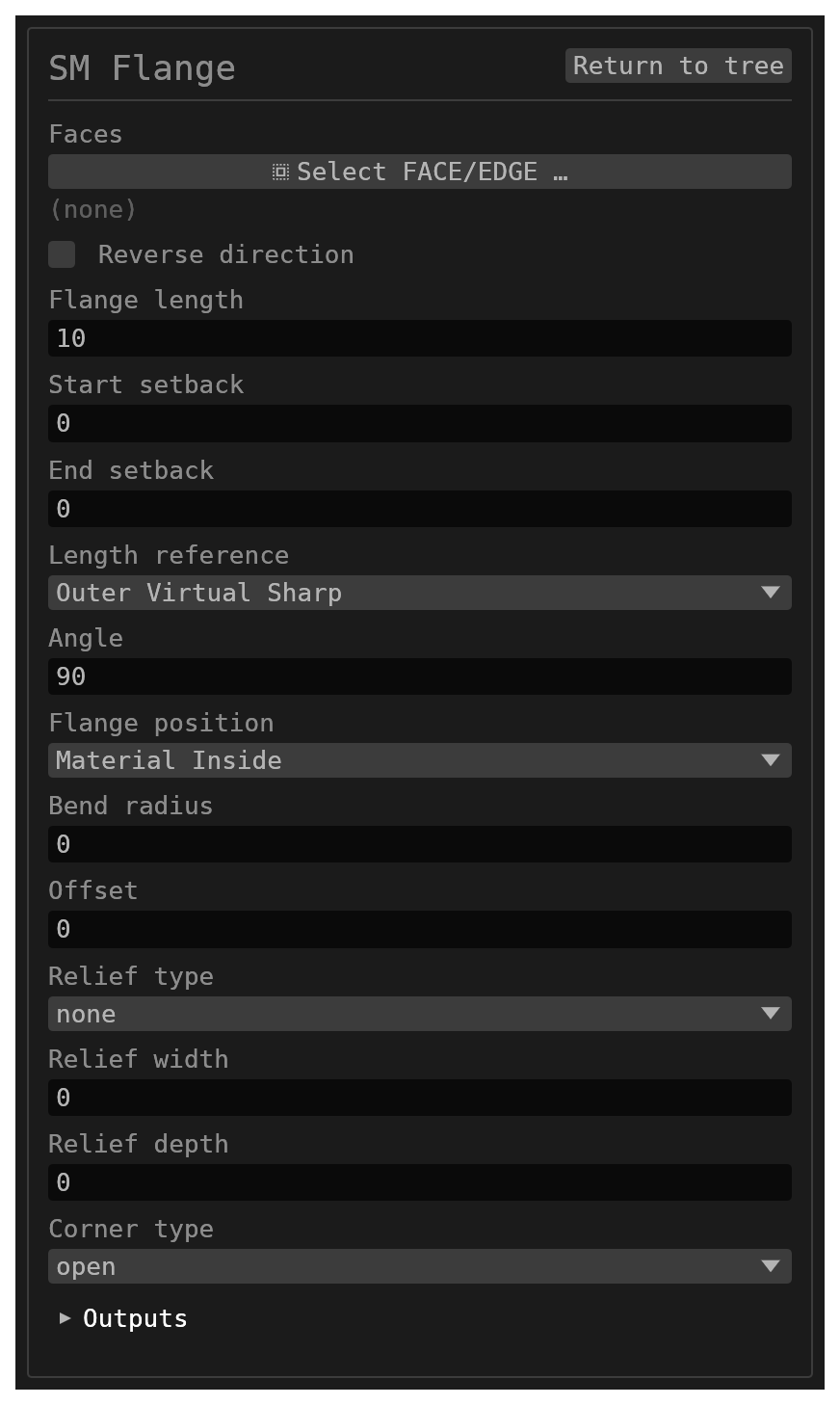
Sheet Metal Flange folds a new wall off each selected edge of an existing sheet-metal body.
Inputs
id–string, defaultnull. Optional identifier for the history entry.faces– multiplereference_selection(FACEorEDGE, defaultnull). Select one or more sheet-metal side-face or hole-bore overlays, or rim edges naming those faces, from one sheet-metal model.angle–number, default90. Bend angle relative to the parent flat.useOppositeCenterline–boolean, defaultfalse. Flips bend direction by changing bend angle sign. A positive signed angle folds toward the parent flat's negative-normal side; a negative signed angle folds toward its positive-normal side. The parent flat's:Aface points along the positive normal.flangeLength–number, default10. Child flat leg length.edgeStartSetback/edgeEndSetback–number, each default0. Trim the active flange span back from the selected edge endpoints.flangeLengthReference–options, defaultOuter Virtual Sharp. The datumflangeLengthis measured from (SolidWorks "length reference"):Inner Virtual Sharp(inner mold-line corner),Outer Virtual Sharp, orTangent to Bend(the bend-tangent line; bends ≥ 90° only).inset–options, defaultMaterial Inside. The flange position relative to the reference edge (an inward fold-line shift):Material Inside = thickness + bendRadius,Material Outside = bendRadius,Bend Outside = 0.bendRadius–number, default0. Inside bend radius override;0inherits the model's stored value; a stored0is treated as0.0001, since a true zero radius cannot revolve.offset–number, default0. Additional signed bend-edge offset (positive = outward, negative = inward).reliefType–options, defaultnone. Bend relief cut at each band end that abuts remaining rim (that is, at a setback end), baked into the parent flat so it shows in the flat pattern.none(default) cuts nothing;rectangularis a square slot;obroundis a stadium slot with an exact rounded deep end;tearis a triangular notch flush with the band end (a true zero-width tear cannot be modelled).reliefWidth–number, default0. Relief slot width along the edge, cut into the rim flush with the band end.0(default) means the sheet thickness.reliefDepth–number, default0. How far the relief reaches past the fold line into the web.0means the neutral-fibre bend allowance,|angle| · (R + k·t).cornerType–options, defaultopen. What happens where two flanges of this feature meet at a convex flat corner.open(default) trims each band to the inset fold-line intersection and removes the corner square, leaving a natural gap the bends can never overlap into;closedextends the earlier-selected wall across the corner and butts the other against it;mitercuts both walls at 45°.closedandmiterrequire a perpendicular corner and a 90° fold.
Behavior
- Adjacent edges use an open corner by default, whether selected together or
flanged in successive features. With 90° folds and
Material Inside, the fold lines are inset by the bend radius plus sheet thickness. The bend bands and walls stop at their shared corner, leaving the corner gap open even whenreliefTypeisnone. - Adding a neighbouring flange can shorten an earlier plain rectangular wall. A wall with cutouts, additional bends, or a shaped end requires explicit setbacks instead; automatic corner trimming does not discard those features.
- A flange never fuses the sheet's side walls: every plate side wall, bend end cap, cutout wall and collar wall stays its own face in the folded body, whichever assembly route built it, so the next flange or hem can be anchored on any individual wall.
insetandoffsetmove the fold line on the parent flat; the flat's outline is patched so it stays closed.- Setbacks are applied before the bend, so a flange can stop short of the edge's corners.
- The body is rebuilt in place under the same name, and the flange appears in its flat pattern.
Hem Variant
Sheet Metal Hem is this feature with the angle fixed at 180°, the
length measured Tangent to Bend, a default flangeLength of 5, and a bendRadius of 0
meaning a knife hem.
Walkthrough
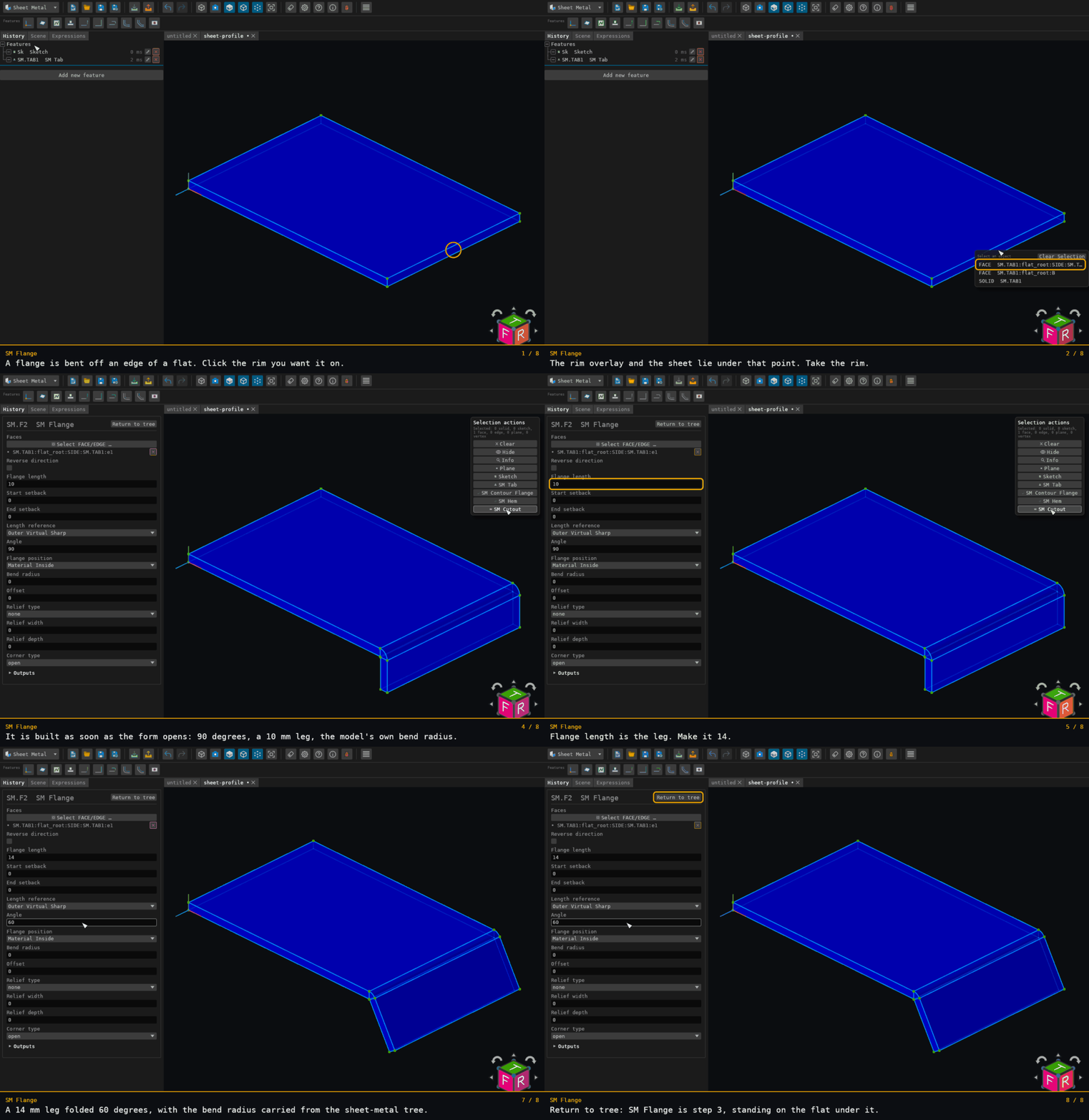
Recorded from the running app by BREP_mcp/tests/videos/sheet-metal-flange.json; regenerate every walkthrough with ./build.sh docs-videos.
The flat is seeded off camera by an SM Tab on a 60 × 40 rectangle (4800 mm³, asserted before anything is clicked); the walkthrough is about the flange.
The pick is a side-face overlay — the selectable rim SM Tab emits for every edge of its flat, and what this feature's Faces field takes. The flange is built the moment the form opens, at 90° with a 10 mm leg, and the walkthrough then changes both.